What is sound?
Sound is caused by a vibration that travels as a wave through a medium (gas, liquid or solid). It is a moving pattern of changing pressure which transfers energy.
Since sound requires a medium to travel through, it cannot travel through space. It is important to note that sound is not a 'thing' itself, it is a property of the medium it is travelling through.
Amplitude
Amplitude, more commonly referred to as volume, is defined by the vertical distance (y-axis) between the peaks and troughs and the x-axis of a sound wave on a typical waveform diagram.
With a higher amount of vibration comes a higher frequency. For example, take the vibration of a guitar string.
You could simply stroke the guitar string gently, which will result in a dynamically soft sound as the string is vibrating a very small amount. However, if you pull the guitar string and release it at a point of great tension, the string will vibrate very far, displacing more air molecules and causing a larger transfer of energy. Therefore, this creates a louder sound, or a larger amplitude.
Frequency
The frequency of a sound wave can be determined through the horizontal distance (x-axis) between the peaks and troughs on a typical waveform diagram. This is known as the wavelength.
Depending on the frequency of a sound wave, the pitch will differ. With a higher frequency comes a higher pitch.
Timbre
Timbre is a French word which dictates the 'tone' of the sound. For instance, a guitar and a violin both have different timbres which allow us to differentiate between the two instruments.
The timbre of a sound is determined by the shape of a sound wave. A sine wave is the most common shape, which consists of a fairly linear display of peaks and troughs. However, there are many different shapes of sound wave, including the sawtooth wave, triangle wave, square wave amongst a plethora of others.
Compression
Compression is when the air particles all bunch up and transfer energy to one another. This is caused by a vibration. The larger the vibration, the more air particles will be displaced and pushed together.
On the other hand, compression may refer to a music production context, where it is used to minimise the difference in amplitude between the softest and loudest sounds. This is done by either making the louder parts quieter (downward compression) or the quiet parts louder (upward compression).
Rarefaction
Rarefaction is when the air molecules spread apart and become less dense. This is the second part of the sequence of the transfer of energy. After rarefaction occurs, the cycle of compression and rarefaction will continue until the sound fades out.

Cycle
The cycle of a sound wave is essentially the 'round trip' back to the starting point. This is demonstrated via the below diagram.
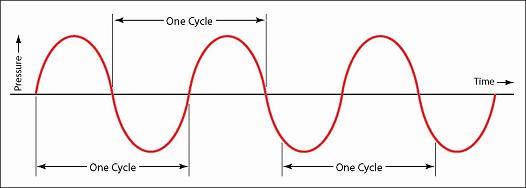
Sine Wave
A sine wave is the most common type of wave and is previously described in this document. For an example of what a sine wave looks like, see above.
Harmonics
Harmonics are sound waves that have a frequency at a set interval from the target note. For example, if the sound's frequency was 1000 Hz, then it might have harmonics at 1500 Hz, 2000 Hz, 2500 Hz, and so on.
Hertz
Hertz are the measurement of frequency in sound, where one hertz equals one vibration per second. Normally, humans can hear between 20 and 20,000 Hz.
Comments
Post a Comment